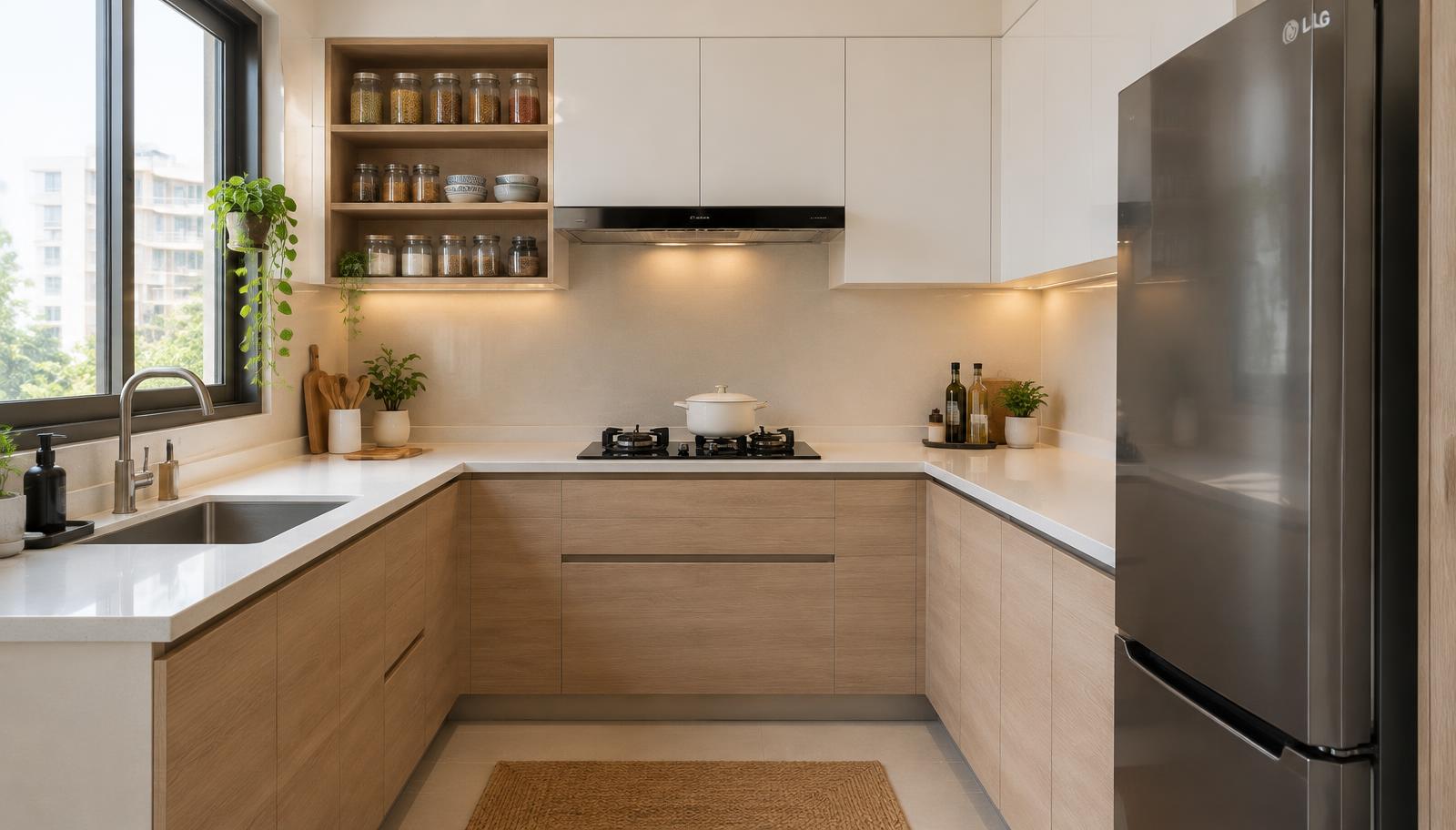
A modular kitchen is often the first thing that comes to mind when people think of a fresh home upgrade, and it is also the one project that scares most homeowners away because of cost. The good news is that a beautiful, functional kitchen does not need a huge budget. With the right choices in layout, materials, and storage, you can get a kitchen that looks premium without draining your savings.
Key Takeaways
- Simple parallel and L-shaped kitchen designs are generally the most budget-friendly layouts, with straight kitchens being the cheapest overall for very small or narrow spaces.
- MDF and particle board are the most affordable materials for cabinets, while BWP plywood is worth the extra cost for areas exposed to moisture.
- Laminate finishes offer a premium look at a fraction of the cost of acrylic or PU shutters.
- Local granite and ceramic tiles are budget-friendly kitchen materials that hold up well for countertops and backsplashes.
- Vertical storage, light colours, and a minimal false ceiling help small kitchens feel bigger without adding cost.
- Smart accessories like pull-out baskets, corner carousels, and pegboards improve daily functionality without needing a big budget.
- Comparing quotes from multiple vendors and sticking to standard cabinet sizes are simple ways to control overall costs.
Why Modular Kitchens Are Still the Smarter Choice
Before we get into the ideas, it helps to understand why modular kitchens make more financial sense than traditional carpenter-built ones in the long run. Modular units are factory made, which means better precision, less material wastage, and fewer surprises during installation. You also get standardized sizes for cabinets and shutters, which keeps costs predictable. Traditional kitchens often run over budget because of on-site labour charges and material wastage, whereas modular setups let you plan and price everything in advance.
That said, modular does not automatically mean expensive. Affordable modular kitchen designs are entirely possible when you focus on smart planning rather than premium finishes. The trick lies in choosing the right combination of layout, cabinet material, and hardware.
Start With the Right Layout for Low-Budget Modular Kitchen Design Ideas
Layout is the single biggest factor that decides both your budget and your daily convenience in the kitchen. Before picking colours or finishes, spend time figuring out which layout suits your space and cooking habits.Simple Parallel and L-Shaped Kitchen Designs
For most small to mid-sized homes, simple parallel and L-shaped kitchen designs remain the most budget-friendly options. A parallel kitchen works well in narrow spaces since it places two counters facing each other, giving you a natural work triangle between the stove, sink, and refrigerator without wasting a single foot of space. It also needs fewer corner units, which are usually the most expensive part of any modular kitchen because of the specialised hardware they require.An L-shaped kitchen, on the other hand, is ideal if your kitchen has one long wall and one shorter adjoining wall. It gives you a good amount of counter space and storage while keeping the cooking zone compact and efficient. Since it usually needs just one corner unit, the overall cost stays lower compared to U-shaped or island kitchens, which demand more cabinetry, more countertop material, and more labour.
L-Shaped vs Straight Kitchen: Which Is Cheaper for Small Spaces
This is a common question, and the honest answer depends on your kitchen shape rather than just the budget number. A straight or single-wall kitchen is generally the cheapest option overall because it uses the least amount of cabinetry, countertop, and backsplash material. If your kitchen is narrow or you are working with a studio apartment, a straight layout keeps costs to a minimum while still giving you enough storage for a small family, and it fits neatly into any small space kitchen layout.
An L-shaped kitchen costs a little more than a straight layout because of the added corner unit and extra counter run, but it makes up for that with significantly more storage and workspace. If your kitchen has some width to work with, an L-shaped design offers better value for money since you get more usable space per rupee spent. So the real comparison is not which one is universally cheaper, but which one matches your kitchen dimensions. A straight layout wins on raw cost, while an L-shaped layout wins on cost per unit of storage and convenience.
Choosing Cost-Effective Kitchen Cabinets
Cabinets typically eat up the largest chunk of any modular kitchen budget, so this is where smart material choices make the biggest difference in your search for cost-effective kitchen cabinets.What Is the Cheapest Material for Modular Kitchen Cabinets
If you are looking for the most affordable option, MDF, or medium density fibreboard, is usually the cheapest material for modular kitchen cabinets that still holds up reasonably well. It has a smooth finish, takes laminate and paint well, and costs noticeably less than plywood or solid wood. The only thing to watch out for is moisture, so it works best for upper cabinets and dry areas rather than directly under the sink.Particle board is another budget option, and it comes in even cheaper than MDF. It is made from compressed wood particles and works fine for low-moisture zones, though it is not as durable as MDF or plywood over the years. For areas that see more wear and tear, like the base cabinets near the sink and stove, spending a bit more on BWP grade plywood, which stands for boiling waterproof plywood, is worth it since it resists moisture damage far better and extends the life of your kitchen.
A smart approach many homeowners use is mixing materials. Use plywood for the base cabinets that face daily moisture and heavy use, and go with MDF or particle board for the upper cabinets that stay dry. This hybrid method keeps your cost-effective kitchen cabinets sturdy where it matters most while saving money everywhere else.
Laminate Over Acrylic or PU Finishes
When it comes to the outer finish of your shutters, laminate is by far the most economical choice. It comes in hundreds of colours and textures, including wood finishes and matte tones that mimic more expensive materials. Acrylic and PU finishes look glossy and premium, but they cost significantly more and show fingerprints and scratches more easily in daily use. A good quality laminate finish can genuinely make your kitchen look high-end while keeping your budget intact.Budget-Friendly Kitchen Materials Beyond Cabinets
Cabinets are not the only place where costs add up. Countertops, backsplashes, and hardware all play a role, and each one has an affordable alternative that does not compromise on looks.For countertops, granite remains a solid budget-friendly kitchen material choice, especially local varieties that cost far less than imported stones or quartz. It is durable, heat resistant, and widely available in Indian markets, which keeps both material and installation costs reasonable. If you want something even cheaper, laminate countertops are an option too, though they are less durable for heavy daily use.
For the backsplash, instead of expensive designer tiles, consider simple ceramic tiles or even a painted, washable wall finish. Ceramic tiles are affordable, easy to clean, and available in enough patterns to still give your kitchen a personality. Ditching handles in favour of push-to-open hardware is another way to shave off a bit more from the budget, since it removes the need for handle installation altogether while giving your kitchen a sleeker, more modern look.
Small Space Kitchen Layout Tips That Save Money Too
If you are working with a small kitchen, the good news is that small kitchens are naturally cheaper to fit out simply because there is less area to cover. But you still need to plan the small space kitchen layout carefully so nothing feels cramped.Keep your work triangle tight. The distance between your stove, sink, and refrigerator should be short enough that you are not wasting steps, but not so cramped that you cannot move comfortably. Vertical storage becomes your best friend in a small kitchen. Instead of spreading cabinets wide, take them up to the ceiling. This gives you more storage without increasing your kitchen's footprint, and it usually costs less than adding extra base units.
Light colours also help small kitchens feel bigger without spending extra money. A white, cream, or light wood laminate finish reflects light and makes the space feel open, and light colours also happen to be some of the most affordable laminate options available since they are mass produced and widely stocked.
Another money saving trick for small kitchens is to skip the false ceiling or keep it minimal. Many homeowners spend a good amount on ceiling work that adds little functional value in a small kitchen. Redirecting that budget toward better cabinets or countertops usually gives a better return.
Low-Cost Kitchen Storage and Smart Accessories
This is where you can really stretch your budget and make daily cooking a lot more convenient. You do not need to buy every accessory in the catalogue. Pick the ones that solve your actual storage problems.Pull-out baskets are one of the most useful and reasonably priced accessories you can add. They make base cabinets far more accessible than a simple shelf, especially for pots, pans, and vegetables. A corner carousel or magic corner unit, while slightly pricier, is worth it if your kitchen has a corner cabinet, since it turns otherwise wasted space into usable storage.
Cutlery trays and drawer organisers are inexpensive additions that keep small items sorted without needing extra cabinets. A wall-mounted rack for spices or utensils is another low-cost kitchen storage and smart accessories solution that frees up counter and cabinet space while keeping frequently used items within reach.
If your budget is really tight, open shelving is worth considering instead of closed cabinets for at least one section of your kitchen. Open shelves cost less than shutters and hinges, and they also make the kitchen feel more open, especially in small spaces. Just be prepared to keep them tidy since everything on display stays visible.
A pegboard system for hanging pots, lids, and tools is another smart, low-cost kitchen storage and smart accessories option gaining popularity because it eliminates the need for extra cabinet space entirely while keeping your kitchen organised and functional.
How Can I Design a Modular Kitchen on a Tight Budget
Designing on a tight budget comes down to prioritising. Start by listing what matters most to you, whether that is storage, counter space, or aesthetics, and put your money there first. Choose a layout that fits your kitchen's actual shape rather than what looks good in inspiration photos, since an ill-fitting layout wastes both space and money.Stick to standard cabinet sizes instead of custom dimensions, since custom work always costs more in both material and labour. Choose laminate finishes over acrylic or PU, and pick MDF or plywood combinations based on where moisture is a concern. Add accessories gradually rather than all at once. You can always add a pull-out basket or an extra organiser later once your budget allows, but the core cabinetry and layout should be sorted right the first time since retrofitting later usually costs more.
Finally, get quotes from more than one modular kitchen dealer or contractor before finalising anything. Prices for the same specifications can vary quite a bit between vendors, and comparing a few options often reveals where you can save without compromising on quality.
Frequently Asked Questions
How can I design a modular kitchen on a tight budget?Focus on a layout that suits your kitchen's shape, stick to standard cabinet sizes, choose laminate finishes over pricier options, and add accessories over time instead of all at once. Comparing quotes from different vendors also helps you find the best pricing for the same specifications.
What is the cheapest material for modular kitchen cabinets?
MDF and particle board are generally the most affordable choices for cabinet carcasses, especially for upper cabinets that stay dry. For areas exposed to moisture, like base cabinets near the sink, BWP grade plywood is a better long-term investment despite the slightly higher cost.
What are the best space-saving ideas for small kitchens?
Vertical storage that goes up to the ceiling, pull-out baskets, corner carousels, and wall-mounted racks all make the most of limited space. Light coloured finishes and minimal false ceiling work also help a small kitchen feel more open while keeping costs down.
L-shaped vs straight kitchen: which is cheaper for small spaces?
A straight kitchen is generally the cheapest option since it uses the least cabinetry and countertop material, making it ideal for narrow spaces. An L-shaped kitchen costs a bit more but offers more storage and counter space, so it often gives better value if your kitchen has some extra width to work with.